
About us
EU-GIFT is an alliance of European higher education institutions whose main objective is to jointly design a strategy focused on excellence in teaching and research, especially in the fields of beverage, differentiated quality foods and sustainable agriculture. Among other benefits, this system will allow students to graduate by combining periods of study in several EU countries through joint study programs.
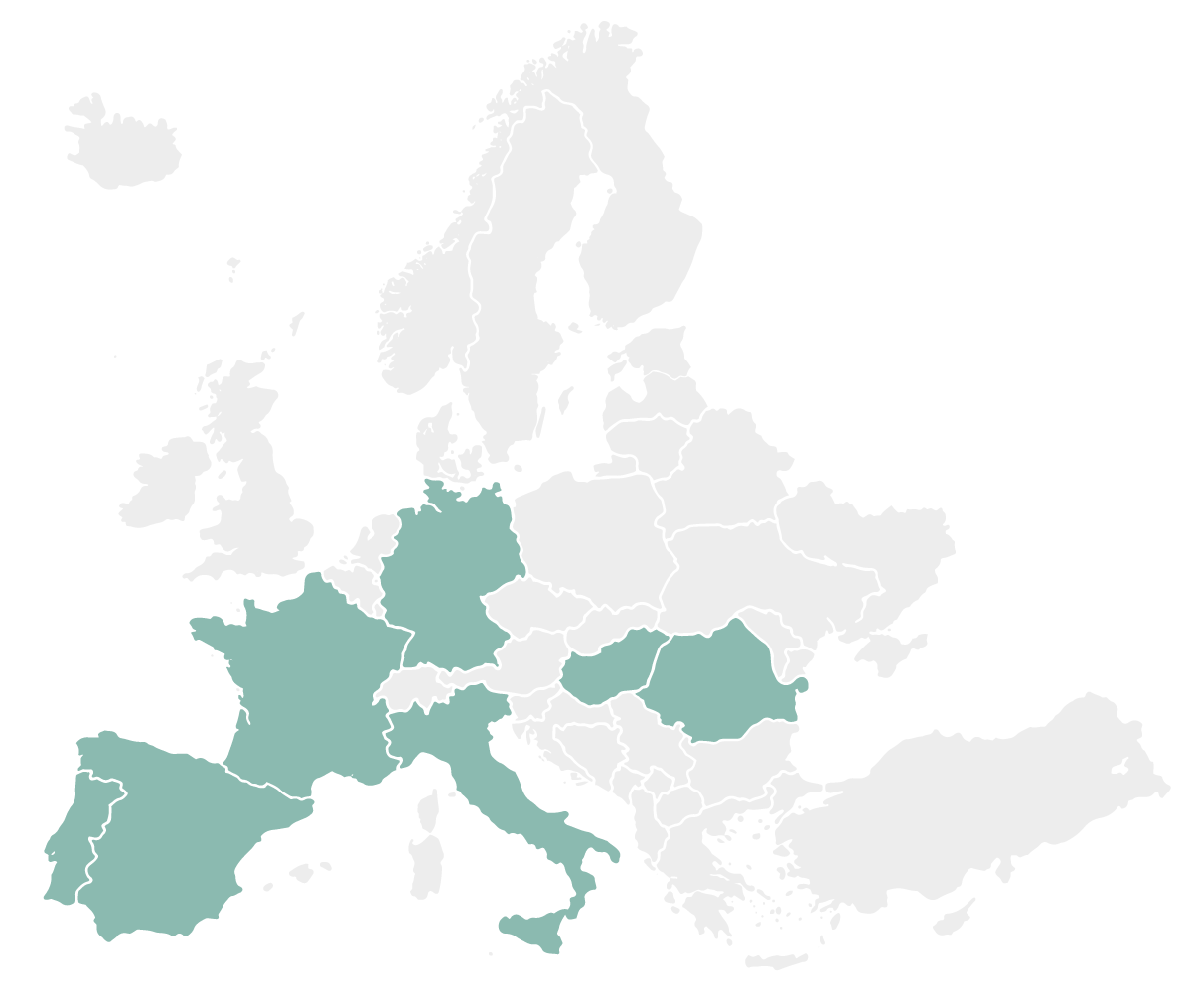


Multidisciplinary Network of European Higher Education Institutions
The alliance aims to be a multidisciplinary network in which other areas will progressively become more important:


Sustainable agriculture

Agritourism

Agricultural Engineering

Food Science

Environmental and Conservation Sciences

Rural Development

Agro-entrepreneurship

Gastronomy

Natural resources management

Agricultural waste management

Business models for sustainable regional food
This network is composed of the following institutions of higher education

University of La Rioja, Spain
The University of La Rioja is a young public university with academic significance located in northern Spain, and at the core of Spain’s renowned wine region, where the agri-food sector is very prominent. The UR offers cutting-edge teaching, pioneering research, and technological advancements in six faculties and schools, and it is involved in the training of future professionals in the agricultural and agri-food sector, which it supports through agreements and research projects. Studies in the agri-food sector are offered at the undergraduate, master’s or doctoral level. Together with other institutions, it leads the well-known Institute of Grapevine and Wine Sciences (ICVV), the only research centre of its kind in Spain. Moreover, the CIVA from University of La Rioja (Centre for Applied and Multidisciplinary Research on Wine and Agri-food) is focused on food and wine research.

University of Verona, Italy
Founded in 1982, the University of Verona is an academic institution with more than 29,000 students and 1,500 teaching, research and technical-administrative staff, committed to a process of continuous improvement by strengthening its human, structural and financial resources. It is a forward-looking university, rooted in the urban environment, with the aim of improving the relationship between academic courses and professional opportunities.

National School of Agricultural Engineering -Bordeaux Sciences Agro-, France
As a higher education and agronomic research establishment under the supervision of the Ministry of Agri- culture, the Bordeaux Sciences Agro university leads agricultural, agri-food and forestry policies. In doing so, it closely collaborates with the industries across these sectors in all its activities including training, research, and transfer, also being a crucial supporter of their transitions towards agroecology, ecology, digitalisation, and food innovation. This assistance aims to develop innovative, cross-disciplinary and systemic approaches at regional, national and international levels.

University of Geisenheim, Germany
Following the steps of its predecessor institution from 1872, the Hochschule Geisenheim University was established in 2013 as a unique type of academic institution which blends the best elements of both a traditional research university and a university of applied sciences, in both its teaching and research endeavours. Its research is based equally on application and theory, the main focus being on the field of special crops in viticulture and horticulture and their diverse production and processing areas. HGU combines this with the fields of fresh produce logistics, food safety, business administration and marketing. Planning and design are two further key areas encompassing landscape architecture, landscape gardening and environmental conservation.

University of Trás-os-Montes e Alto Douro (UTAD), Portugal
The University of Trás-os-Montes and Alto Douro is a prestigious institution for the creation, transmission and dissemination of culture, knowledge, and science stemming from the Polytechnic Institute of Vila Real, which started teaching in 1973, and became a University in 1986. It is located in Vila Real, in the North of Portugal, in the fringe to the Alto Douro Wine Region, a World Heritage Site, famous for its landscape, wines and gastronomy. UTAD, as the leading national institution on the science of viticulture, oenology, and local value food chains, develops science in innovation in a quintuple helix model focused on tackling the societal challenges. For the application of this model, a successful ecosystem was created, where students are steered and challenged to develop their entrepreneurial skills.

University of Eszterházy Károly, Hungary
The Eszterházy Károly Catholic University is a medium-sized state-recognised institution situated in the North-Eastern part of Hungary. The institution comprises two campuses, in Eger and Jászberény, is home to five faculties – Arts and Humanities, Economics and Social Sciences, Informatics, Education, Natural Sciences – and a Centre for Research & Development and has over 6,000 students at varying educational stages. The EKCU is located in a rural area, hence contact with food producers and processors is essential. The study of short food supply chains plays an important role in the university’s research on regional economics. The institution also performs food science research which currently focuses mainly on medicinal plants, probiotics and reprobiotics.

University of Agricultural Sciences and Veterinary Medicine of Cluj-Napoca, Romania
Founded in 1869 as the Institute of Agronomic Studies, the University of Agricultural Sciences and Veterinary Medicine Cluj-Napoca is a prestigious Life Science University in Romania, combining tradition and modernity in research, development, and innovation. It aims to promote excellence in education, research, and innovation in the field of agriculture and veterinary medicine. It is the only Romanian university ranked in Shanghai Ranking’s Global Ranking of Academic Subjects for Veterinary Sciences in 2019, 2020, 2021 and 2022 and Food Science and Technology in 2022 and is also among the top Romanian HEIs in Scimago Institutions Rankings, RUR World University Ranking, and the national ranking based on international hierarchies.
| EU-GIFT member | Students | Staff | Number of Faculties | Number of Research Centres or Institutes |
|---|---|---|---|---|
| University of La Rioja | 4,583 | 827 | 8 | 62 |
| Bordeaux Sciences Agro | 753 | 165 | 6 | 14 |
| Eszterházy Károly Catholic University | 6,143 | 872 | 5 | 5 |
| Hochschule Geisenheim University | 1,718 | 553 | 20 | 2 |
| University of Agricultural Science and Veterinary Medicine of Cluj-Napoca | 5,463 | 768 | 6 | 35 |
| University of Tras-os- Montes e Alto Douro | 8,400 | 1,080 | 5 | 16 |
| University of Verona | 29,300 | 1,577 | 13 | 8 |
Joint Management Structures
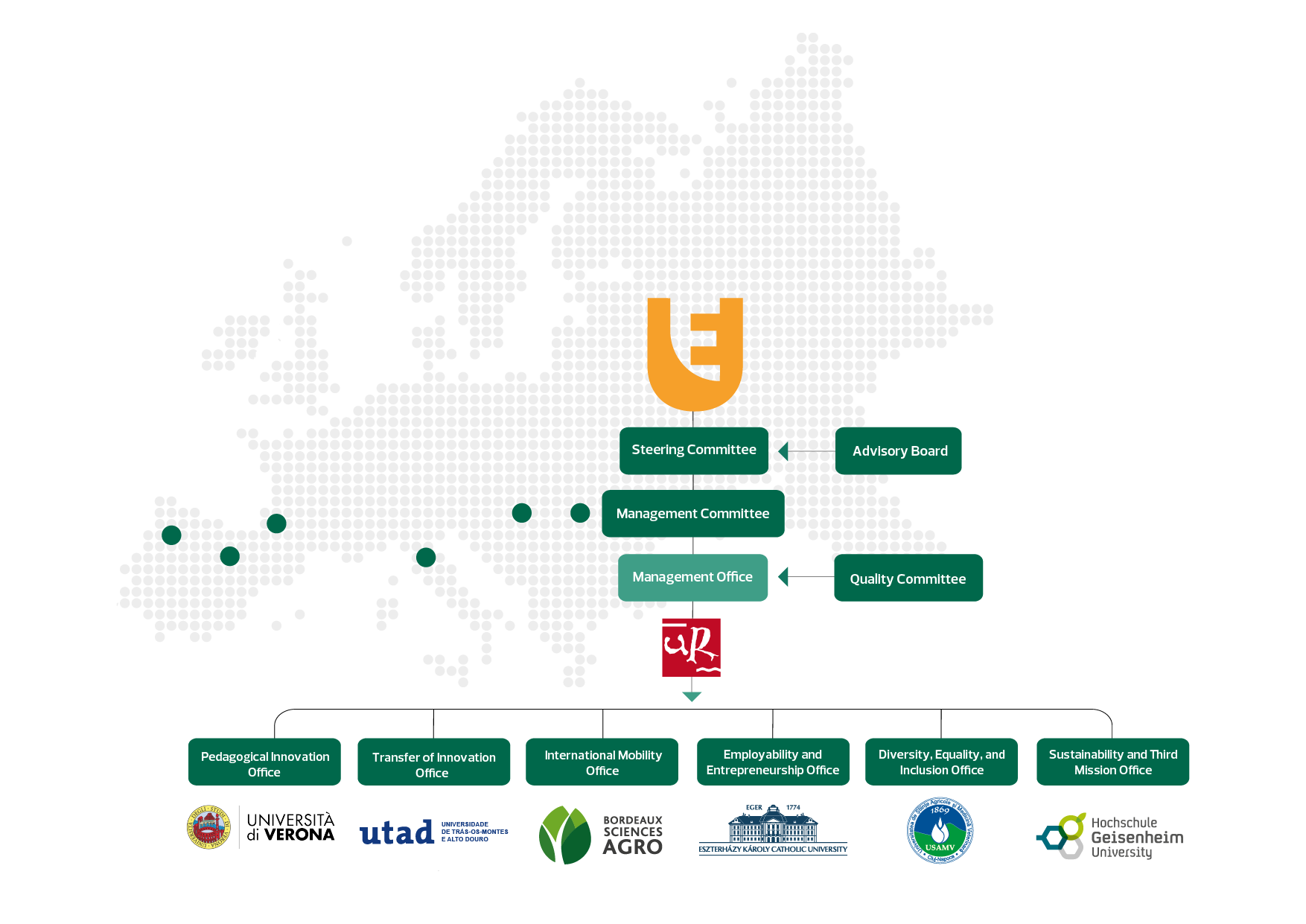
The governance structure of EU-GIFT Alliance is being organised into five interconnected layers, each composed of different committees and bodies, as outlined below:
- Steering Layer (Steering Committee)
- Steering Layer (Managing Committee)
- Performing Layer (WP Coordination Team and Joint Offices).
JointOffices:
· The EU-GIFT Management Office
· The International Mobility Office
· The Pedagogical Innovation Office
· The Transfer of Innovation Office
· The Diversity, Equality, and Inclusion Office
· The Sustainability and Third Mission Office
· The Employability and Entrepreneurship Office - Advisory Layer (Advisory Board)
- Quality Committee


Funded by the European Union. Views and opinions expressed are however those of the author(s) only and do not necessarily reflect those of the European Union or the European Education and Culture Executive Agency (EACEA). Neither the European Union or EACEA can be held responsible for them.